In one of the most fascinating breakthroughs in modern neuroscience, scientists have successfully mapped and reconstructed the brain of a tiny fly inside a computer. This achievement represents a major step toward understanding how biological brains work and how intelligence emerges from neural connections.
The research focused on the brain of the Drosophila melanogaster, one of the most studied organisms in science. Despite its extremely small size, the fruit fly’s brain contains a surprisingly complex network of neurons.
By digitally reconstructing this network, scientists were able to simulate the structure of the brain inside a computer system, opening new possibilities for neuroscience and artificial intelligence research.
Why scientists study the fruit fly brain
The fruit fly has been used in laboratories for more than a century because it is simple enough to study but still shares many biological similarities with larger animals.
Its brain contains roughly 140,000 neurons, far fewer than the approximately 86 billion neurons found in the human brain. Even so, those neurons form millions of connections that control behavior, movement, and sensory processing.
Because of its manageable size, researchers can map the entire neural network of a fruit fly in ways that would be nearly impossible with larger brains.
Building a digital brain map
To reconstruct the fly’s brain, researchers used extremely advanced imaging techniques that allowed them to scan tiny slices of brain tissue at microscopic resolution.
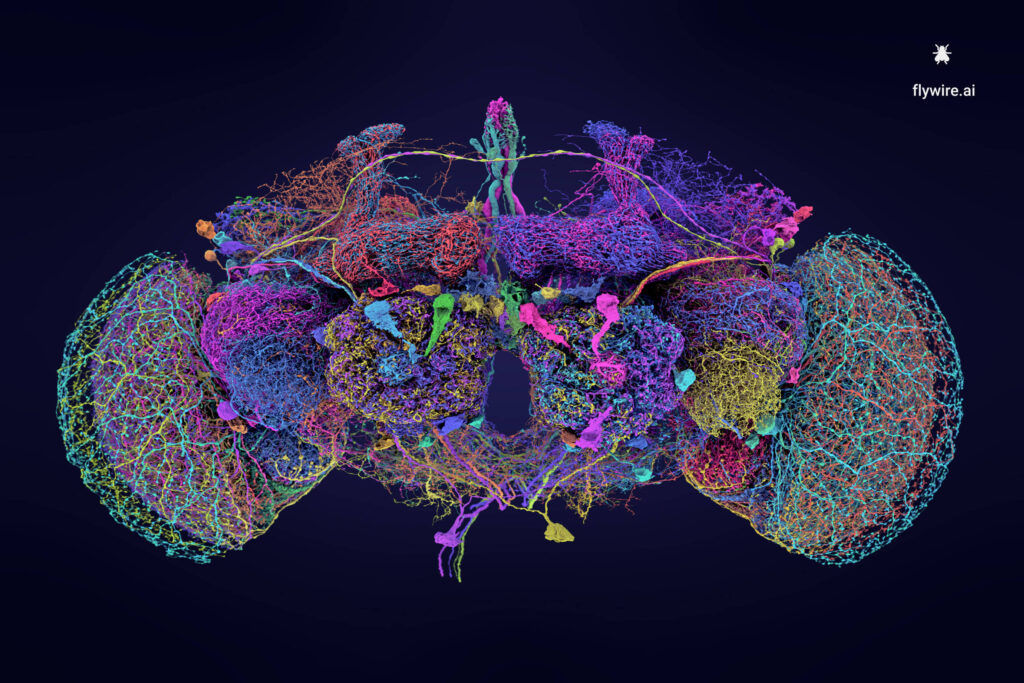
Scientists then traced each neuron and its connections, building what neuroscientists call a Connectome.
The resulting dataset contained millions of neural connections. With this information, researchers were able to recreate a detailed digital model of the fly’s brain structure inside a computer.
This digital reconstruction allows scientists to study how signals move through the neural network and how different parts of the brain interact.
How the brain was simulated in a computer
Once the neural map was completed, scientists used powerful computing systems to simulate how the neurons communicate.
By modeling electrical signals between neurons, the computer can mimic how information flows through the brain of the fly. This does not mean the fly’s consciousness was transferred into a machine, but it does mean that researchers can observe how its neural circuits function in a virtual environment.
This type of simulation helps scientists test ideas about learning, decision-making, and sensory processing without performing invasive experiments on living animals.
Why this discovery is important
Mapping the brain of a fruit fly may sound small compared to the complexity of the human brain, but the implications are enormous.
Understanding how relatively simple brains process information could help scientists uncover universal principles of neural computation. These insights may contribute to advances in robotics, medicine, and machine learning.
The research also represents an important milestone in the field of Neuroscience, bringing researchers closer to understanding how biological intelligence works.
The long-term goal: understanding the human brain
Many scientists believe that mapping increasingly complex brains will eventually help humanity understand the fundamental mechanisms of intelligence.
Projects studying organisms like the fruit fly are often considered the first steps toward much larger goals, including mapping mammalian brains and eventually understanding the neural structure of humans.
Although that goal remains far in the future, the successful digital reconstruction of a fly brain demonstrates how rapidly neuroscience and computing technologies are advancing.
Each new discovery brings researchers closer to answering one of science’s biggest questions: how the brain produces thought, behavior, and consciousness.