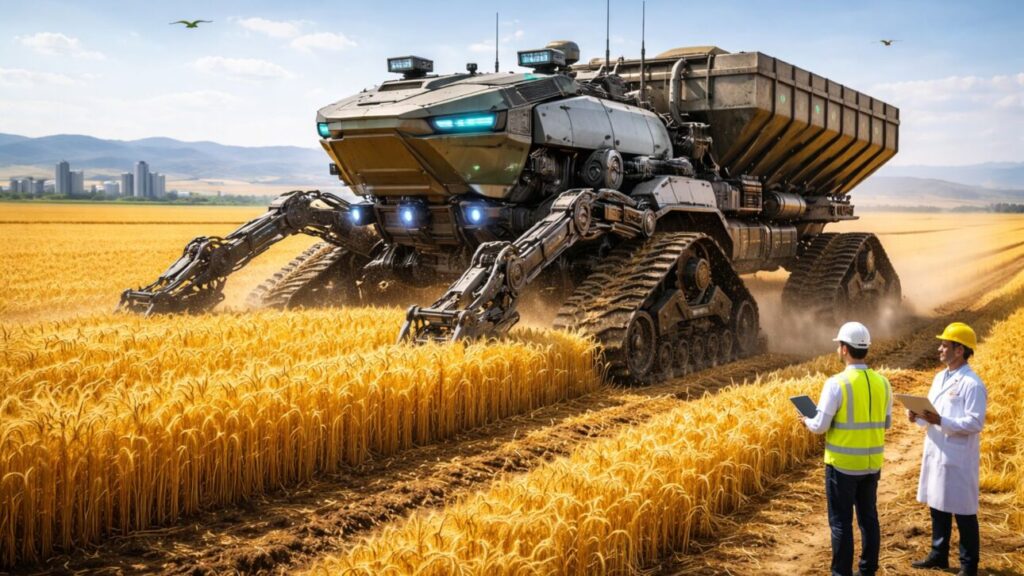
China has introduced a highly advanced agricultural system that many experts are calling a technological breakthrough. The new platform combines drones, autonomous tractors, ultra-precise navigation, environmental sensors and artificial intelligence to create what researchers describe as a fully integrated smart farming system.
The project, developed with support from the Chinese Academy of Agricultural Sciences, aims to modernize agriculture and significantly increase efficiency in large-scale farming operations.
According to researchers, the system can coordinate multiple machines simultaneously while analyzing real-time data from the field.
How the system works
The technology integrates several tools that normally operate separately into a single intelligent network.At the center of the system are autonomous tractors guided by satellite navigation with extremely high precision. These machines can move through fields with centimeter-level accuracy, allowing them to plant, fertilize and harvest crops with minimal error.At the same time, aerial drones survey the farmland from above, capturing images and environmental data that help monitor crop health and soil conditions.The system processes this information instantly using AI algorithms that determine what actions are needed in different parts of the field.
Precision farming at a new level
Precision agriculture has been developing for years, but this new approach attempts to push the concept much further.
Using sensors placed across the farmland, the system continuously measures variables such as soil moisture, temperature, and nutrient levels. The autonomous machines then adjust their operations based on that data.
For example, the system can,automatically decide:,where to add fertilizer,when irrigation is needed
which areas require pest control
how planting patterns should change
This approach reduces waste and can improve crop yields while lowering environmental impact.
The role of drones in modern agriculture
Agricultural drones have become increasingly important in farming over the past decade. Companies such as DJI have already developed specialized drones used to spray crops, monitor plant growth and analyze farmland.
In the new system, drones function as the “eyes in the sky,” constantly collecting data and sending it to the central control platform.
By combining drone imagery with ground sensors and machine learning models, the system can identify problems in crops before they become visible to farmers.
A glimpse of the future of farming
Experts believe technologies like this could play a major role in the future of global agriculture. As the world population grows, farmers will need more efficient ways to produce food using limited land and resources.
Smart farming systems that combine automation, satellite navigation and AI could help address those challenges.
While this technology is still evolving, the project shows how rapidly agriculture is becoming a high-tech industry driven by robotics, data and advanced computing.
For many researchers, systems like this represent the beginning of a new era in farming—one where fields are managed not just by farmers, but also by intelligent machines working together. 🌾🚜🚁